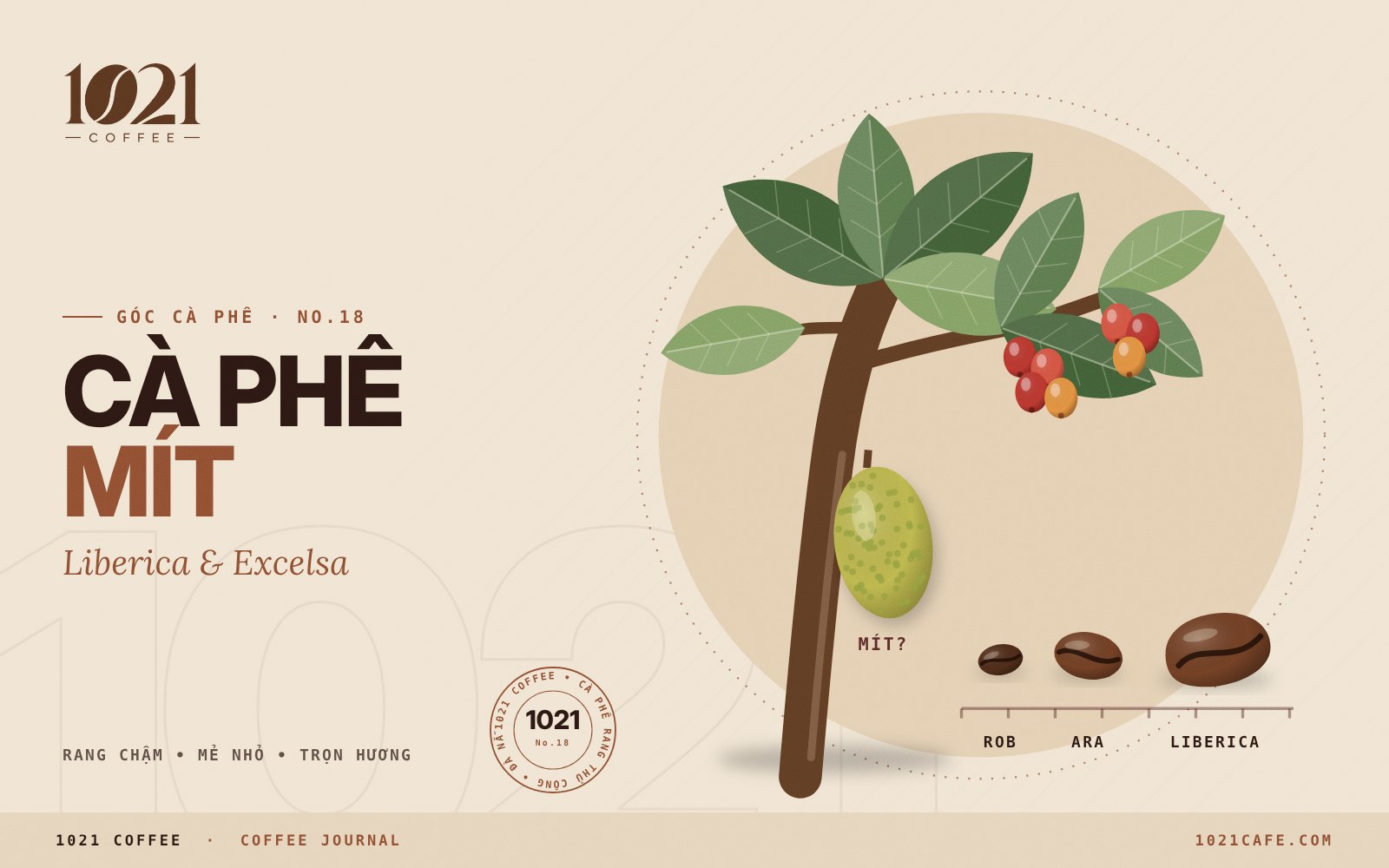
Vietnamese has three homely names for coffee: cà phê chè (“tea coffee”, Arabica), cà phê vối (Robusta) and cà phê mít, “jackfruit coffee”. The third is the one you rarely see on a shelf, yet it belongs to a family with real character: Liberica and Excelsa. The trees are huge and hardy, the leaves thick and glossy, and the flavour is something people tend to either love or avoid.
What are Liberica and Excelsa?
Liberica (Coffea liberica) comes from West and Central Africa and takes its name from Liberia. In the late 19th century, when coffee leaf rust wiped out many Arabica farms in Asia, Liberica was planted as a replacement in places such as Indonesia, Malaysia and the Philippines. The Philippines’ well-known Barako coffee is largely Liberica.
Excelsa used to be classed as a species of its own. In the mid-2000s botanists folded it into Liberica as a variety (Coffea liberica var. dewevrei). The coffee trade still calls it Excelsa, though, because it tastes quite different from “classic” Liberica.
As for the jackfruit name, explanations vary. The one you hear most is that the thick trunk and big, glossy leaves look a lot like a jackfruit tree. In Vietnam the name usually means Excelsa, and sometimes Liberica too.
How they differ from Arabica and Robusta
| Arabica | Robusta | Liberica / Excelsa | |
|---|---|---|---|
| Plant | Shrub, usually pruned low | Large shrub | A true tree; can pass 10 m if left unpruned |
| Bean | Oval, curved crease | Small, round, straight crease | Liberica large, often lopsided and teardrop-shaped; Excelsa smaller |
| Flavour | Bright, aromatic, sweet | Bitter, heavy body | Liberica: smoky, woody, ripe fruit. Excelsa: tart, dark-fruit acidity |
Together they make up only a tiny share of the world’s coffee. They cope well with heat and disease, but the big cherries ripen unevenly, which makes picking and processing harder work.
Jackfruit coffee in Vietnam
In parts of the Central Highlands and the south, you’ll find cà phê mít planted here and there: around the edge of a farm, as a windbreak, or mixed in with Robusta. It has mostly gone into blends to add acidity and weight. Lately some farmers and roasters have started processing it more carefully and presenting Excelsa as a coffee in its own right.
If you want to try it
- Roast: a medium roast keeps the fruit while staying sweet; go too dark and it turns harshly smoky and woody.
- Phin: about 20–25 g of coffee to 100–120 ml of water at 92–96 °C, brewed the way we describe in our phin guide.
- Pour-over: 1:15 ratio, water at 90–93 °C, medium grind.
- Blending: try 20–30% Excelsa with Robusta for a strong cup with a lift of fruity acidity.
Tip: Start drinking while it’s warm and let the cup cool slowly. A lot of the fruit only shows up once the coffee drops in temperature.
At 1021 we work with Vietnamese Arabica and Robusta. To get to know those two better, read Arabica vs Robusta.