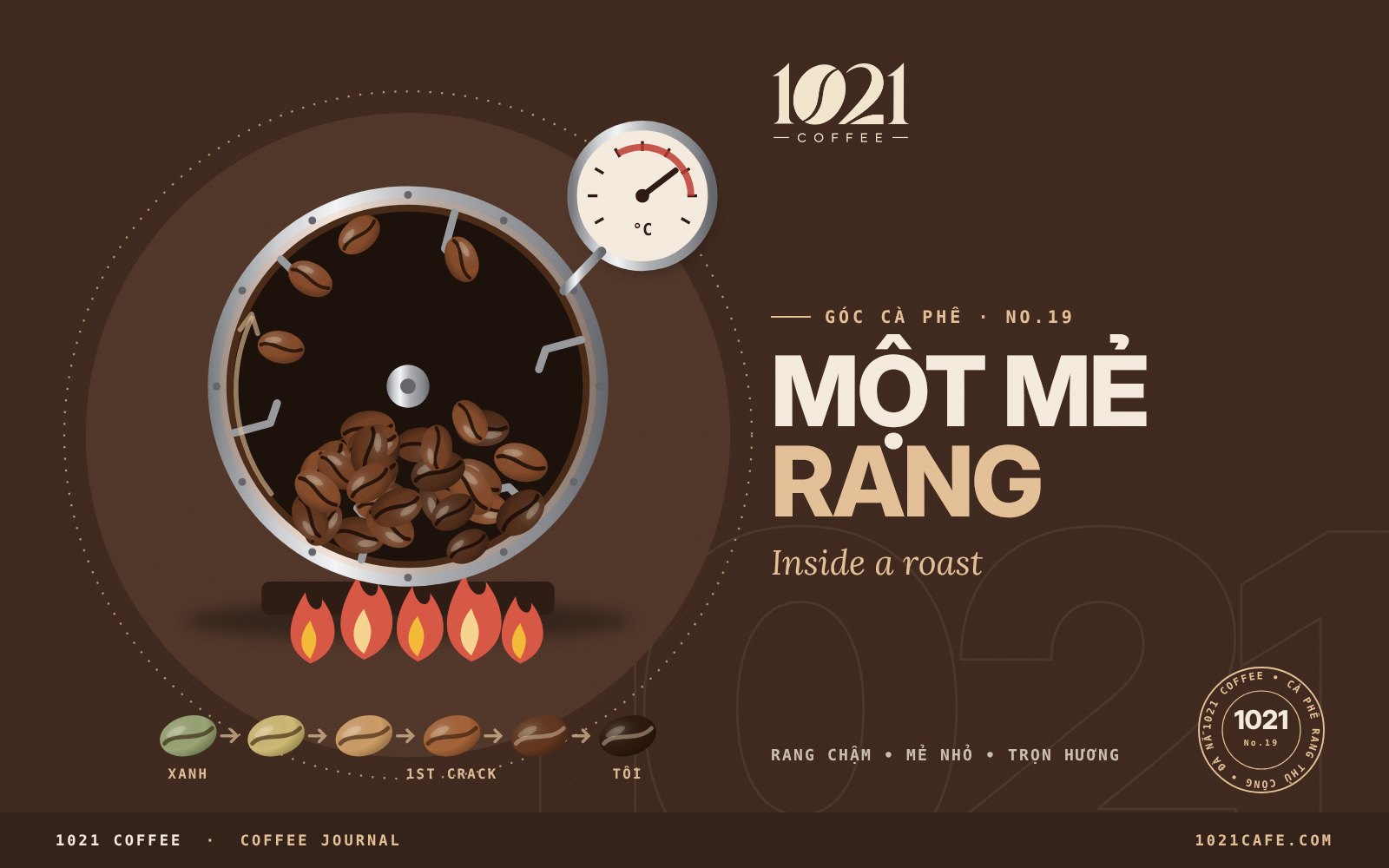
Green coffee barely smells like coffee at all. It is hard, faintly grassy and holds around 10–12% moisture. Every aroma we love only appears once the beans are roasted, when hundreds of chemical reactions unfold inside each seed over the course of ten-odd minutes.
The four main stages
- Drying. In the first minutes, heat drives water out of the bean. The colour shifts from green to pale yellow and the smell turns bready, a bit like straw. Rush this stage and the core of the bean cooks unevenly.
- Maillard reactions. As the beans climb towards roughly 150 °C, sugars and amino acids react, building brown colour and a huge range of aromas: toast, nuts, malt.
- Caramelisation and first crack. Sugars begin to caramelise. Steam and CO₂ build up inside until the bean splits with an audible crack, usually somewhere around 195–205 °C depending on the roaster and how it is measured. From here on, the coffee is drinkable.
- Development. The time after first crack shapes much of the final flavour. The longer it goes, the more acidity fades and bitterness and body grow. Push on to second crack and oils start to surface, with smoky, burnt notes becoming obvious.
How the bean changes
| Trait | Green | Roasted |
|---|---|---|
| Colour | Grey-green | Light to dark brown |
| Moisture | About 10–12% | Usually under 3% |
| Weight | 100% | Down by roughly 12–20% |
| Volume | Small, dense | Larger, brittle, porous |
The bean loses water, so it gets lighter, yet it swells because its inner structure turns porous. That is why a dark-roasted bean looks bigger but feels lighter in the hand.
Roasting is also a balancing act between what is gained and what is lost. Acids that give brightness break down as the roast goes on, while sugars turn into caramel and then, if pushed too far, into bitter, burnt compounds. Each roast level is a different point on that path, which is why the same green coffee can taste fruity at one level and chocolatey at another.
Why people talk about slow roasting
There is no single correct roast recipe. Roasters adjust heat and time to the bean, its moisture and how it will be brewed. Still, if heat is pushed too hard, the outside can darken while the centre stays underdeveloped, which tends to taste harsh and astringent. A gentler approach lets heat travel through the bean more evenly.
At 1021 we roast slowly in small batches, with no additives or flavourings, so the flavour comes from the coffee itself. To compare roast levels side by side, see our piece on roast levels.
Tip: Freshly roasted beans are still releasing CO₂. Give them a little time before brewing; our article on resting coffee after roasting explains why.