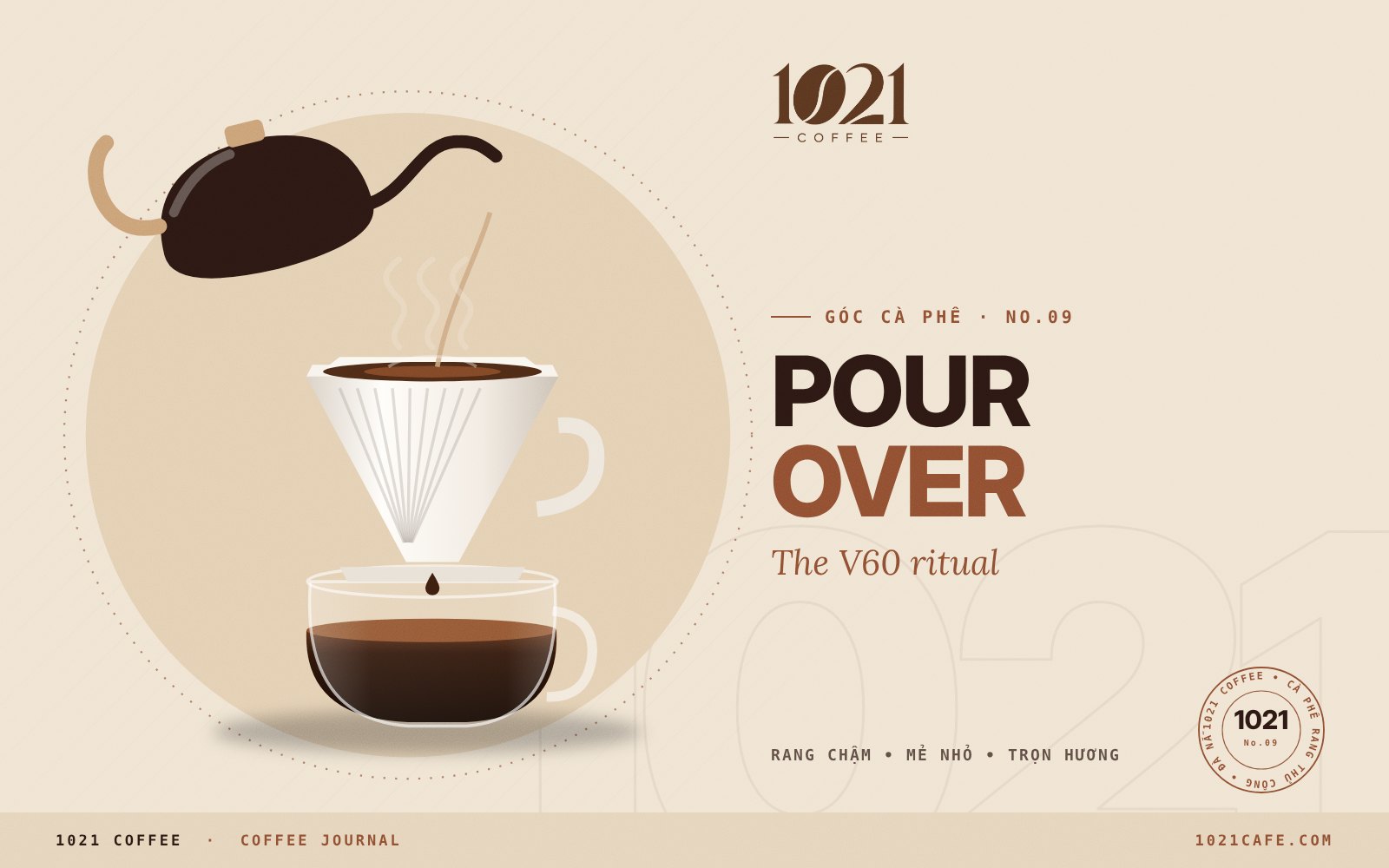
If the phin gives you a cup that's bold and syrupy, pour over gives you one that's clean, bright and layered. You pour hot water by hand over coffee in a paper-lined cone; the paper traps most of the oils and fines, so the flavours come through clearly, especially acidity and fruit. It's the ideal way to enjoy Arabica, such as Arabica from Cầu Đất in Lâm Đồng.
Gear
- A V60 (or similar cone dripper) and matching paper filters.
- A gooseneck kettle for a controlled pour. A regular kettle works, but it's hard to pour evenly.
- A digital scale with a timer, or a scale plus a phone timer.
- A grinder, ideally a burr grinder. Pour over is very sensitive to grind, so Signature Roast whole beans ground right before brewing give the best results.
The base recipe (one cup)
| Variable | Value |
|---|---|
| Coffee | 15 g |
| Water | 225–240 g (1:15 to 1:16) |
| Water temperature | 92–96 °C |
| Grind | Medium-fine, like slightly fine beach sand |
| Bloom | 30 g of water (twice the coffee weight), 30–45 s |
| Total time | 2:30–3:30 |
Step by step
- Rinse the filter with hot water to remove papery flavours and warm the dripper and cup. Discard the water.
- Add the coffee, give it a gentle shake to level the bed, set it on the scale and tare.
- Bloom: start the timer and pour 30 g of water in a circle until all the grounds are wet. Wait 30–45 seconds while the coffee releases CO₂.
- Second pour: pour slowly in a spiral from the centre outwards (avoid pouring onto the paper itself) up to about 130–150 g.
- Final pour: once the level drops a little, pour on to 225–240 g in total, finishing by about 1:45–2:00.
- Let it drain. Give the dripper one gentle swirl to flatten the bed. It should finish draining between 2:30 and 3:30.
Tip: When you're done, the coffee bed should be flat. Lots of grounds stuck high on the paper, or a deep crater in the middle, usually means the pour was too aggressive or uneven.
Troubleshooting
| What happens | Usual cause | Fix |
|---|---|---|
| Drains in under 2:15; sour, weak cup | Grind too coarse, pouring too fast | Go one step finer; pour slower and steadier |
| Takes over 4 minutes; bitter, astringent, drying | Grind too fine, fines clogging the filter | Go one step coarser; stir and swirl less |
| Time is right but it tastes thin | Too much water for the dose | Move from 1:16 to 1:15, or use 16 g of coffee |
| Sour and bitter at once | Uneven extraction from pouring to one side | Spiral evenly and wet every grain during the bloom |
| No bloom at all | Old coffee, or ground long ago | Use freshly roasted beans and grind just before brewing |
Where to start
Stick to the base recipe for your first few brews and only change the grind, since it has the biggest effect. Our grind size guide has a full comparison chart. Once your brews are consistent, try making two different coffees side by side and tasting them using our home tasting guide. The differences may surprise you.